Sustainable Bathroom · 2026-06-21
Why Most Body Wash Is Mostly Water
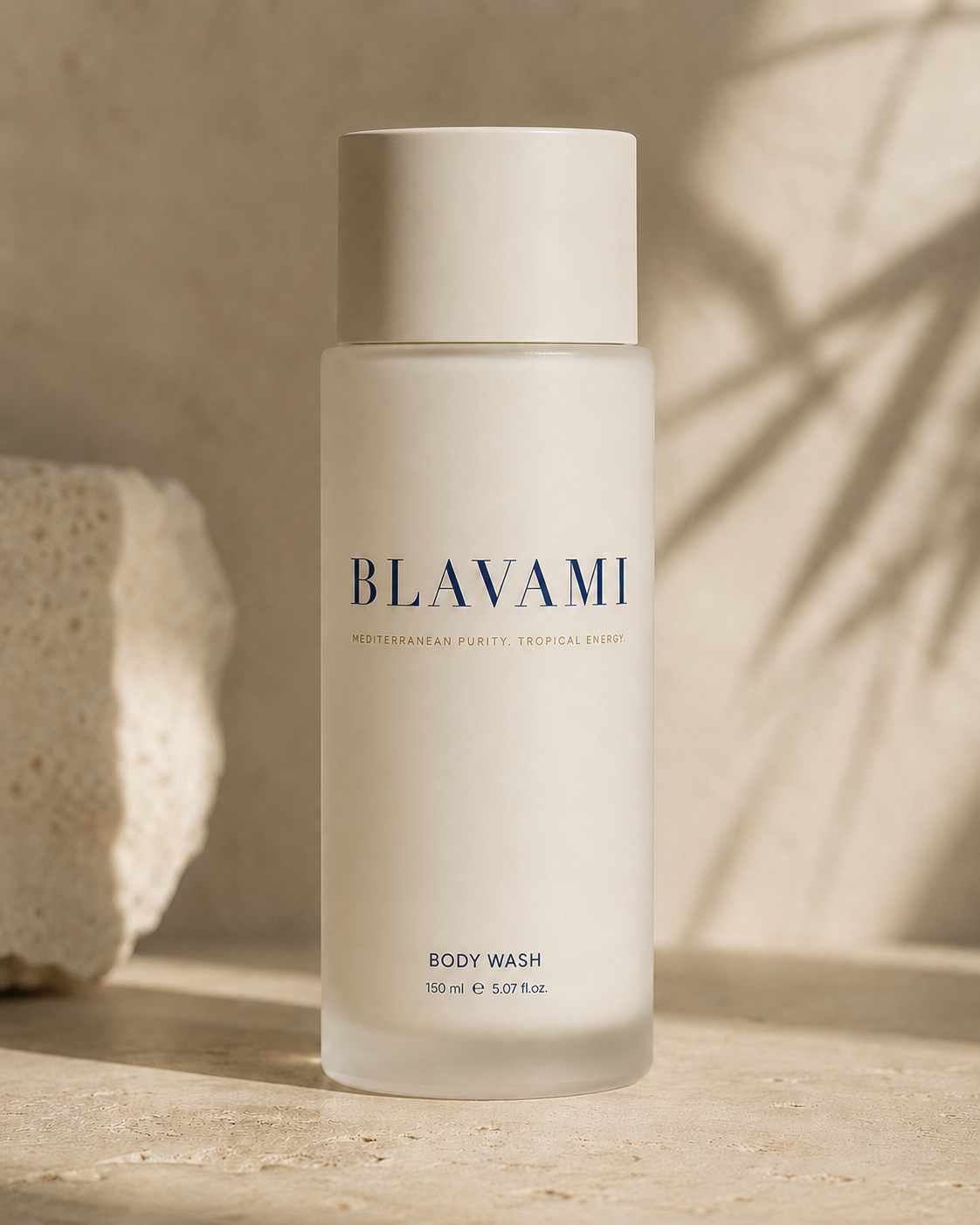
Most body wash is sold as a finished liquid.
That sounds obvious, but it is worth pausing on. When you buy a traditional bottle of body wash, you are not just buying cleansing ingredients, fragrance, texture, and packaging. You are also buying the water that has already been added to the formula.
Water is not bad. Water is essential to how body wash works. It helps dissolve, dilute, spread, rinse, and carry the rest of the formula.
The question is not whether water belongs in the final product. The question is whether that water needs to be shipped inside a disposable bottle before the product ever reaches your bathroom.
At Blavami, we think that question is worth rethinking.
Why liquid body wash became normal
Liquid body wash became popular because it is convenient.
It is ready to use. It is easy to squeeze. It feels familiar. It sits neatly in the shower. For many people, it feels more modern than a bar of soap and more sensorial than a basic cleanser.
There is nothing wrong with that experience. In fact, Blavami is not trying to reject the pleasure of liquid body wash. We like the ritual: the texture, the fragrance, the way a good wash spreads in the shower.
But the liquid format also creates hidden inefficiencies. Finished liquid is heavy. Heavy products cost more to move. They require packaging that can contain liquid safely. They are more likely to leak. And when the bottle is empty, many people throw it away and repeat the cycle.
The hidden weight of water
A finished liquid body wash has to be transported from the place it is manufactured to the place it is sold or delivered. That means the water inside the bottle moves through the supply chain too.
This is one of the reasons concentrated formats are interesting. If the active product can be shipped in a more concentrated form, and the customer adds water at home, some of that transport weight can potentially be reduced.
Powdered body wash applies that idea to the shower.
Instead of shipping the full liquid experience, the brand ships a concentrated powder. The customer adds water in a reusable bottle. The product becomes body wash closer to the moment of use.
It is a simple idea, but simple does not mean easy. The formula still has to work beautifully.
Why not just use bar soap?
Bar soap is one answer to the water problem. It is compact, usually low in water, and often uses less packaging than liquid body wash.
But not everyone wants bar soap.
Some people prefer the feel of liquid body wash. Some dislike sharing a bar. Some want a more fluid texture. Some want a product that feels more like a modern shower gel. Some want a format that fits into a refillable bottle system.
Powdered body wash is interesting because it can offer another path. It can reduce some of the weight and packaging problems of liquid body wash while still aiming for a liquid or gel-like experience after water is added.
That is the space Blavami is exploring.
The reusable bottle matters
A powder format only makes sense if the bottle is part of the system.
If every powder refill came with another disposable bottle, the benefit would be limited. The real idea is to keep a bottle and refill it.
That means the bottle cannot be an afterthought. It needs to be attractive enough to stay in the shower, durable enough to reuse, and practical enough to make the ritual feel easy.
At Blavami, the bottle is part of the product experience. The ritual is not only “add water.” It is prepare, shake, hydrate, use, and repeat.
The bottle should feel like something you want to keep.
Less water shipped does not mean impact-free
It is important to be honest here.
A powder format does not automatically make a product perfect. Sustainability depends on many details: packaging materials, refill format, shipping routes, manufacturing, ingredient sourcing, and customer behavior.
A reusable bottle only helps if people reuse it. Smaller refills only help if the overall system is designed well. A concentrated format only matters if the product still performs and people continue using it.
That is why Blavami uses careful language. We say “designed to reduce water weight” and “intended to reduce reliance on single-use plastic,” not “zero impact” or “perfectly sustainable.”
The goal is practical progress, not exaggerated claims. Read more about our sustainability approach and ingredient philosophy.
Why this matters for travel and gym bags
The water issue is not only about sustainability. It is also about convenience.
Liquid body wash can leak in a suitcase. It can take up space in a gym bag. It can trigger travel-size limitations. It can make packing more annoying than it needs to be.
Powder refills are lighter and easier to carry. They do not behave like traditional liquids before mixing. For people who travel often, train regularly, or move between places, that difference can be meaningful.
This is one of the reasons Blavami is not just a bathroom product. It is also a travel and active-life product.
The premium challenge
There is a risk with concentrated and lower-waste products: they can feel like homework.
That is not good enough.
If a product asks someone to change a habit, it has to make the new habit feel worthwhile. It should not feel like a downgrade. It should not feel like a science project. It should not feel like something you only use because you feel guilty.
A powdered body wash has to become something beautiful in the shower.
That means the texture must feel good. The fragrance must feel refined. The bottle must feel intentional. The ritual must feel easy. The product must cleanse and rinse in a way that earns repeat use.
This is the hardest part of building Blavami. The water problem is obvious. The product experience is where the brand has to prove itself.
A better question
The question is not “Is water bad?”
Water is not bad.
The better question is: where should the water be added?
Traditional body wash adds it before shipping. Powdered body wash adds it closer to use. That one change opens up a different way to think about packaging, transport, refills, travel, and the shower ritual itself.
Blavami exists because we think that different way is worth building. Explore the product concept or browse more Blavami Learn guides.
FAQs
Is body wash really mostly water?
Traditional liquid body wash is a water-based product. The exact percentage varies by formula, but water is typically a major part of the finished product.Why does body wash need water?
Water helps dissolve and carry ingredients, supports texture, and makes the product easy to spread and rinse.Is powdered body wash water-free?
Before mixing, powdered body wash is a dry or low-water format. Water is added by the customer to create the finished body wash.Does using powder make a product automatically sustainable?
No. Impact depends on packaging, shipping, manufacturing, ingredients, and whether the bottle is actually reused.Why is Blavami focused on this format?
Blavami is developing a premium powder-to-body-wash ritual designed to reduce water weight, support a reusable bottle system, and make body wash easier to travel with.Blavami is developing a premium powder-to-body-wash ritual designed to reduce water weight, reduce reliance on single-use plastic when used as designed, and make body wash easier to live with. Join the early access list to follow the launch.
Join the Blavami prelaunch list
Blavami is developing a premium powder-to-body-wash ritual designed for less water shipped, a reusable bottle, and easier travel.
Join Early AccessRelated articles
What Makes a Body Wash Feel Luxurious?
Luxury body wash is about more than fragrance. Texture, spreadability, lather, rinse feel, packaging, and ritual all matter.
Read moreWhat Is Powdered Body Wash?
Powdered body wash is a concentrated cleansing format that turns into body wash when water is added. Here’s how it works and why brands like Blavami are exploring it.
Read moreWhat Is Inulin in Body Care?
Inulin is a plant-derived ingredient often used in personal care for formula feel and ingredient storytelling. Here’s why it matters in powder-to-body-wash development.
Read more